Ready to Take the Next Step?
 Hey there!
Select your preferred option to kickstart the proposal process for your company.



If you’re a small business owner, marketing probably feels harder than it should.
There are endless platforms to choose from, tools promising quick wins, and advice coming from every direction. One person says you need social media. Another swears by SEO. Someone else insists ads are the answer. Meanwhile, you’re short on time, working with a limited budget, and just trying to figure out what will actually move the needle.
At Flyrise, we work with small businesses every day. Founders, owners, and lean teams who are doing their best to grow without massive budgets or in-house marketing departments. Helping them build practical, focused small business marketing solutions has shown us that the same frustrations come up again and again, regardless of industry.
These aren’t personal failures. They’re small business marketing challenges, and they’re incredibly common.
The problem isn’t that small businesses aren’t trying hard enough. It’s that most marketing advice is built for bigger teams, bigger budgets, or companies that can afford to experiment endlessly. Small businesses need clarity, focus, and a smarter way to decide what matters now versus what can wait.
In this guide, we’re breaking down the four most common small business marketing challenges we see in real life, and how to overcome them without doing more marketing. Just better marketing.
Nearly every struggling marketing effort can be traced back to the same core issues. These challenges don’t exist in isolation. They stack on top of each other and compound when there’s no clear system in place.
Let’s start with the root of almost all marketing frustration.

This is the challenge that causes all the others.
Most small businesses don’t lack effort. They lack direction.
Marketing often starts with tactics instead of strategy. A business launches an Instagram account, runs a few ads, sends an email campaign, maybe writes a blog post or two. Each action feels reasonable on its own, but together they don’t form a clear plan.
This is what we call random acts of marketing. And it’s far more common than most business owners realize. Research shows that 67% of small and mid-sized businesses do not have a documented marketing plan, and 73% report low confidence in the effectiveness of their marketing strategy. In other words, many small businesses are making decisions without a clear roadmap and without confidence that what they’re doing is working.
Without a clear strategy, it becomes almost impossible to answer basic questions like:
When those answers are fuzzy, marketing gets expensive fast. Time and budget get spread thin across too many initiatives, messaging becomes inconsistent, and results feel unpredictable.
For small businesses, every decision matters more. There’s less room for trial and error, and fewer resources to recover from missteps. When strategy is missing, marketing feels like constant motion with very little momentum.
This is why many owners feel stuck doing “all the things” without seeing real growth.
The fix isn’t more tactics. It’s starting with strategy.
At Flyrise, the first phase of our framework is Plan, and it exists for one reason: clarity.
Before you build anything or promote anything, you need to get clear on:
You don’t need to be everywhere. You need to be intentional.
A focused strategy helps you decide what to say no to just as much as what to prioritize. It turns marketing from a guessing game into a roadmap.
If you’re looking for a grounded place to start, these small business marketing strategies that stand the test of time are a great next step:
It reinforces the same idea you’ll see throughout this post and throughout our playbook: smarter strategy beats bigger budgets every time.

If the first challenge is about direction, this one is about capacity.
Most small businesses aren’t short on ideas. They’re short on hours in the day and dollars in the bank. A recent survey of small businesses found resource limitations like budget and time were among the top marketing challenges, with many SMB owners reporting that limited staff and resources make it harder to execute consistent marketing.
Marketing happens in between client work, operations, sales, and everything else that keeps the business running. It’s squeezed into nights, weekends, or the occasional slow week.
That’s where this small business marketing problem really shows up.
Marketing becomes inconsistent. Projects get started but not finished. Campaigns launch and quietly fade out. Even good ideas don’t get enough time or budget to work.
Small businesses are built to be lean. Owners and small teams wear a lot of hats by necessity. That makes it incredibly easy for marketing to fall into a cycle like this:
On top of that, limited budgets often get spread too thin. A little money goes to ads. A little goes to tools. A little goes to content. None of it gets enough focus to build momentum.
The result isn’t failure. It’s fatigue.
The answer isn’t finding more time or magically increasing your budget. It’s being more intentional with both.
This is where the Produce phase of the Flyrise framework comes into play.
Instead of trying to do everything, small businesses need to focus on building and maintaining the essentials first:
When time and budget are limited, consistency matters more than volume. One channel done well will outperform five channels done halfway.
It also helps to get realistic about where your money is going. Many small businesses feel like they have “no budget” for marketing, when in reality the issue is that spending isn’t aligned with priorities.
If this sounds familiar, this guide on how to create a small business marketing budget is a helpful place to reset. It walks through how to think about marketing spend as a tool, not a gamble.
The goal isn’t to stretch yourself thinner. It’s to make sure the time and budget you do have are working together toward something clear.
By the time most small businesses reach this point, they’re doing a lot of things. They’re just not doing them together.
This marketing challenge for small businesses shows up when your website says one thing, your social media says another, your emails sound different again, and your ads feel disconnected from all of it. Each channel might look fine on its own, but together they don’t tell a clear story.
From the outside, that inconsistency creates friction. From the inside, it creates confusion.
Small businesses usually add marketing channels over time. A website first. Then social media. Then maybe email. Later, ads or SEO. Each piece gets built at a different moment, often by different people, with different priorities in mind.
Without a unifying plan, those channels become silos.
This is also where time and budget constraints from the previous challenge make things worse. When you’re stretched thin, it’s tempting to treat each channel as a separate task instead of part of a bigger system. Post when you can. Email when you remember. Update the site when something breaks.
The result isn’t bad marketing. It’s scattered marketing.
Inconsistent execution doesn’t just look messy. It makes your marketing less effective.
When messaging shifts from channel to channel:
People don’t experience your marketing one channel at a time. They experience it as a whole. When that experience feels disjointed, they hesitate.
The fix here isn’t to add more content or more platforms. It’s to align what you already have.
This is where the Promote phase of the Flyrise framework comes in.
Promotion isn’t about being everywhere. It’s about using the right mix of channels to support a clear message and goal. That starts with treating your website as your home base, not just another channel.
From there:
One helpful way to think about this is through a funnel lens. Instead of asking, “What should I post today?” ask, “Where is this sending someone next?”
Alignment creates momentum. When your channels reinforce each other, marketing feels less like juggling and more like progress.
By this point, many small businesses are doing something in every area. There’s a website. There are posts. Maybe emails, ads, or blog content. But when you ask a simple question like “What’s actually working?” the answer often isn’t clear.
This small business marketing challenge is one of the most stressful because it undermines confidence. When you can’t connect effort to outcomes, every decision feels like a guess.
And this isn’t rare. According to a recent Forbes report, 33% of small businesses say they struggle to understand what’s working or measure marketing performance, even when they’re actively investing time and money into marketing efforts.
Measurement usually gets skipped for understandable reasons. It feels technical. It feels overwhelming. And when time is limited, tracking results often feels less urgent than getting the next thing out the door.
On top of that, small businesses are often flooded with metrics that don’t really matter. Likes. Impressions. Page views. Numbers go up and down, but none of them clearly answer the question every owner is asking:
Is this helping my business grow?
Without a clear answer, it’s hard to know what to keep, what to improve, and what to stop doing altogether.
When results aren’t tracked:
This is also where burnout creeps in. When effort and outcomes aren’t connected, motivation drops. Even smart marketing starts to feel pointless.
The goal isn’t to track everything. It’s to track the right things.
This is where the Optimize phase of the Flyrise framework comes in. Optimization turns marketing into a feedback loop instead of a guessing game.
For most small businesses, that means:
You don’t need a complex dashboard. You need clarity.
Once you can see what’s driving real engagement, optimization becomes practical instead of intimidating.
If all four of these challenges sound familiar, it’s not because you’re behind or missing something obvious. It’s because most small businesses are trying to apply marketing advice that was never designed for how they actually operate.
Much of today’s marketing guidance assumes time to test constantly, teams to execute consistently, and budget to experiment without immediate payoff. Small businesses rarely have any of those things. They’re lean by necessity, not by choice.
That mismatch creates friction.
Strategies become too broad to execute. Tactics pile up faster than they can be sustained. Measurement feels complicated instead of helpful. Over time, effort increases while clarity disappears. Marketing starts to feel like a collection of disconnected tasks instead of a system that supports growth.
This is what we see repeatedly when working with small businesses. The challenges don’t come from lack of effort or motivation. They come from skipping structure. Without a clear order of operations, even good ideas compete with each other for attention.
That’s how small business marketing challenges keep repeating, even when you’re doing “all the right things.”
The solution isn’t more tactics. It’s a system that fits the reality of small business constraints.
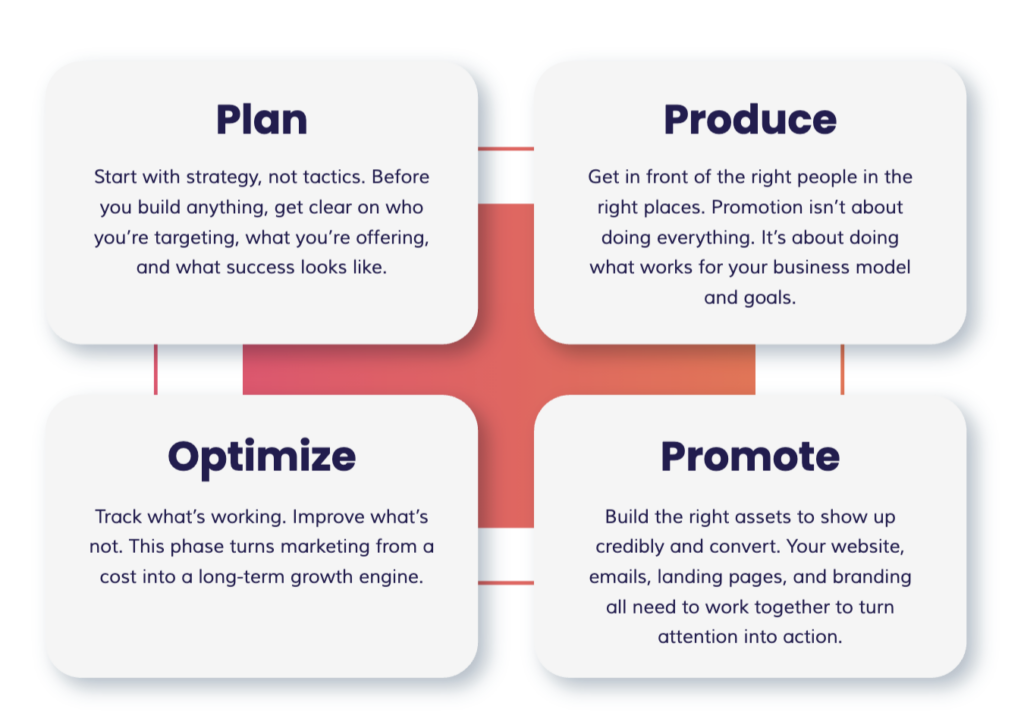
This is the framework we use at Flyrise to help small businesses bring structure and clarity to their marketing without adding complexity.
Once you see it laid out, one thing becomes clear: order matters.
Most small business marketing problems don’t come from doing the wrong things. They come from doing the right things in the wrong order. Promoting before planning. Adding channels before building a foundation. Measuring results before deciding what success actually looks like.
This framework is designed to prevent that.
Instead of asking small businesses to do everything at once, it creates momentum by focusing on one phase at a time. Each step supports the next. Nothing competes for attention.
The simplicity is intentional. Small businesses don’t need more complexity. They need a system that respects limited time, limited budgets, and real-world constraints.
When marketing follows a clear sequence, decisions get easier. Focus improves. And instead of feeling scattered, effort starts to compound.
If marketing has felt overwhelming, inconsistent, or harder than it should be, you’re not alone. These small business marketing challenges show up for a reason. Not because small businesses aren’t capable, but because most marketing advice doesn’t account for real-world constraints.
The good news is that none of these challenges require you to do more marketing. They require you to do the right marketing, with structure.
When you step back, prioritize what matters, and follow a clear sequence, things start to change. Decisions get easier. Effort feels more focused. And instead of scrambling from tactic to tactic, marketing begins to support the business instead of draining it.
If you want help applying this approach to your specific business, a free marketing strategy session is a good place to start. It’s a chance to talk through what’s working, what’s not, and where to focus next without committing to anything or adding more to your plate.
Better marketing doesn’t come from doing everything. It comes from doing the right things in the right order.